The modern home is a fortress, not just of walls and locks, but of intelligent technology designed to keep you and your loved ones safe. In today’s interconnected world, ensuring your home’s security often boils down to choosing the right smart devices. Two of the most popular and effective tools in this arsenal are indoor security cameras and smart doorbells. While both offer valuable surveillance capabilities and peace of mind, they serve distinct purposes and excel in different scenarios. Understanding their unique strengths and how they complement each other is essential for crafting a truly comprehensive home security strategy. This guide will help you navigate the nuances, compare the features, and ultimately decide which solution, or combination of both, is the optimal choice for your home right now.
Understanding Home Security: Indoor Cameras vs. Smart Doorbells
The landscape of home security has dramatically evolved, moving beyond simple alarms to sophisticated, internet-connected devices that offer real-time monitoring and control from anywhere. This evolution brings with it a variety of tools, each designed to address specific security needs. Indoor security cameras provide crucial visibility into the heart of your home, monitoring internal spaces and activities. Smart doorbells, on the other hand, act as the first line of defense, guarding your primary entry points and facilitating safe communication with visitors. The decision isn’t always about choosing one over the other; often, the most secure homes integrate both technologies to create a layered defense, providing a holistic view of both external threats and internal peace of mind. Without a clear understanding of what each device offers, homeowners might overlook critical vulnerabilities or invest in solutions that don’t fully align with their unique security priorities.
Indoor Security Cameras: Your Eyes Inside
Indoor security cameras are surveillance devices designed specifically for monitoring the interior spaces of your home. They provide a continuous or motion-triggered visual record of what happens within your property, offering an invaluable layer of security and oversight. These cameras are not merely for deterring intruders; their utility extends to a wide array of daily needs, making them a cornerstone of modern smart homes.
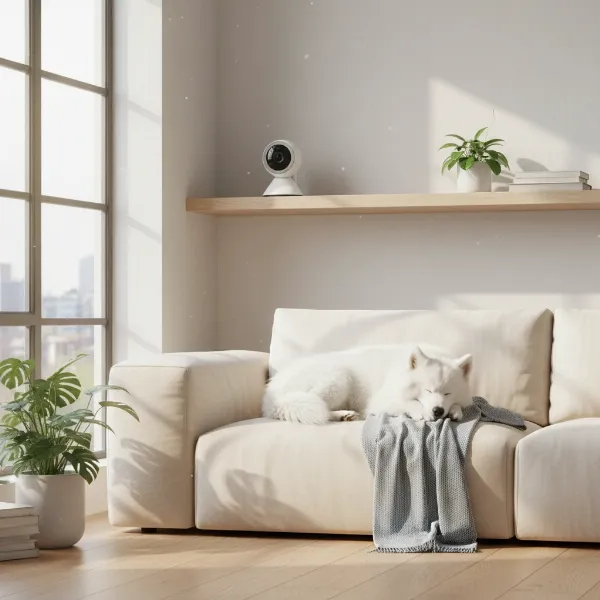 An indoor security camera subtly mounted in a modern living room, monitoring a pet sleeping on a couch
Key Applications:
- Monitoring Children, Pets, or Elderly Family Members: For parents, pet owners, or those caring for elderly relatives, indoor cameras offer invaluable peace of mind. You can check in on your kids playing, soothe an anxious pet with two-way audio, or ensure an elderly family member is safe and comfortable, all from your smartphone, no matter where you are.
- Deterring Potential Intruders: While primarily internal, the visible presence of indoor cameras can deter opportunistic burglars who manage to breach the exterior. Knowing they are being recorded can be a strong disincentive. In the event of an actual break-in, the footage captured becomes critical evidence.
- Providing Evidence for Incidents: Should an unfortunate event occur, such as a theft, vandalism, or even an accidental fall, the recorded footage from an indoor camera provides irrefutable evidence. This is vital for law enforcement investigations and insurance claims, helping to identify culprits and streamline recovery processes.
- Keeping an Eye on Internal Movements: Whether it’s monitoring the activities of a nanny, a house cleaner, or other service providers, indoor cameras offer transparency and accountability. They ensure that household rules are followed and that everyone within your home is safe and acting appropriately.
Indoor cameras have evolved to offer high-definition video quality, advanced motion detection often powered by AI to differentiate between people and pets, and seamless integration with broader smart home ecosystems, making them an indispensable tool for internal surveillance.
Smart Doorbells: The Sentinel at Your Entryway
Smart doorbells represent the evolution of the traditional doorbell, integrating a camera, microphone, and speaker into a single device that connects to your home’s Wi-Fi network. Positioned at your primary entry points, they serve as a vigilant sentry, offering real-time insights and control over who approaches your home. This technology transforms a simple chime into a sophisticated security hub, fundamentally changing how you interact with your doorstep.
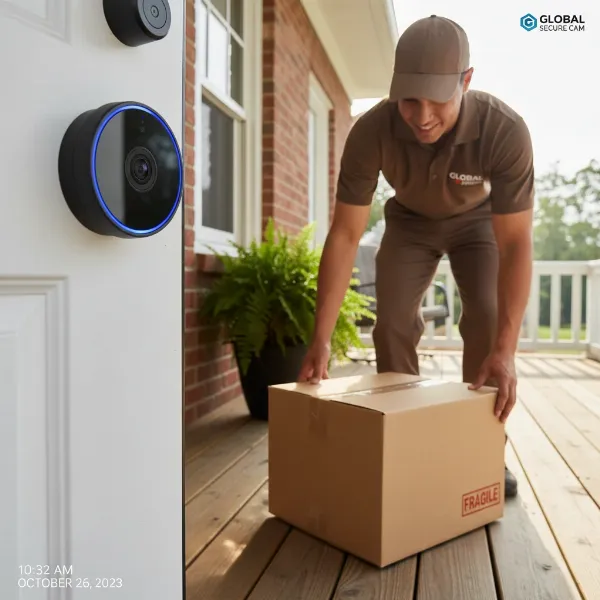 A smart doorbell capturing a package delivery by a person, with a clear view of the front porch
Key Applications:
- Seeing and Speaking to Visitors Remotely: One of the most significant benefits of a smart doorbell is the ability to see and communicate with anyone at your door from anywhere, using a smartphone app. Whether you’re at work, on vacation, or simply in another room, you can answer the door, giving the impression you’re always home.
- Package Delivery Monitoring and Theft Deterrence: “Porch piracy” is a growing concern. Smart doorbells, particularly those with advanced motion detection and package alerts, can notify you when a delivery arrives and when it’s picked up. Their visible presence and recording capabilities often deter would-be thieves, and if a package is stolen, the footage provides crucial evidence.
- Knowing Who’s at the Door When You’re Away: Beyond scheduled deliveries, smart doorbells notify you of any activity at your front door, from friends dropping by to unexpected visitors. This insight allows you to screen guests, instruct service providers, or simply be aware of who is approaching your home, enhancing your control and safety.
- Screening Unexpected Visitors: With a smart doorbell, you never have to open your door to a stranger. You can see who is there, hear what they have to say, and respond (or choose not to) without direct contact, adding a significant layer of personal security. This is particularly valuable for individuals living alone or when children are home unsupervised.
Smart doorbells effectively extend your presence to the front door, offering convenience, security, and deterrence with a singular focus on your home’s most common point of entry.
Head-to-Head Comparison: Indoor Security Camera vs. Smart Doorbell
While both indoor security cameras and smart doorbells contribute significantly to home security, their distinct designs and primary functionalities lead to notable differences in performance and application.
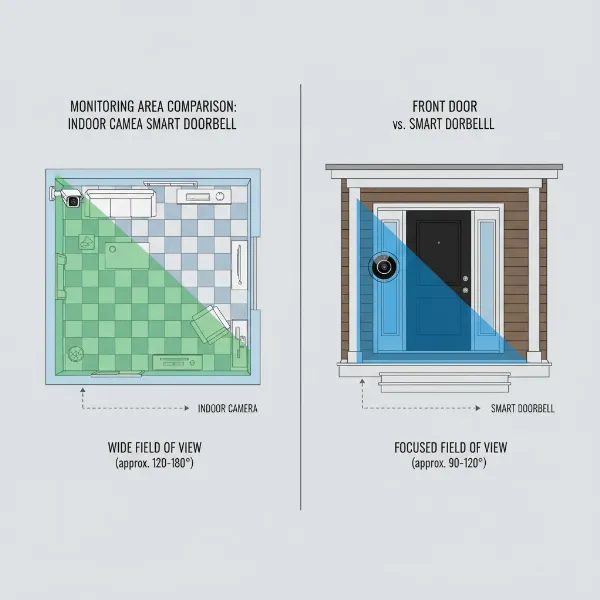 A diagram illustrating the different fields of view and typical placement for an indoor security camera (wide room coverage) and a smart doorbell (focused entryway coverage)
Field of View and Coverage
|
Our Picks for the Best Indoor security camera in 2026
As an Amazon Associate I earn from qualifying purchases.
|
||
| Num | Product | Action |
|---|---|---|
| 1 | AOQEE 2K Cameras for Home Security-Outdoor/Indoor Camera for Dog/Cat/Pet/Nanny/Baby/Elderly, Color Night Vision, White Light, Siren, 24/7 SD Recordings, Works with Alexa, Plug in (C1-White-2pack-2.4G) |

|
| 2 | Cinnado Security Camera Indoor-2K 360° WiFi Cameras for Home Security,Pet/Dog/Baby Camera with Phone app, 2-Way Audio, Night Vision, 24/7 SD Card Storage, Works with Alexa & Google Home (2.4Ghz)-D1 |
|
| 3 | Blink Mini - Compact indoor plug-in smart security camera, 1080p HD video, night vision, motion detection, two-way audio, easy set up, Works with Alexa – 1 camera (White) |
|
| 4 | Blink Mini 2K+ (newest model) – Plug-in Home & Pet Indoor Security Camera with 2K video resolution, night vision, enhanced audio, motion detection – 2 cameras (Black) |
|
| 5 | Tapo 2K Indoor Pan/Tilt Wired Security Camera - Works as a Baby Monitor & Pet Camera, Motion Detection, 2-Way Audio, Siren, Night Vision, No-Subscription Local Storage or Optional Cloud, C211 (2-Pack) |
|
| 6 | Ring Indoor Cam, Home or business security in 1080p HD video, White |
|
| 7 | Tapo 1080P Indoor Wired Security Camera - Works as a Baby & Pet Monitor, Motion Detection, 2-Way Audio, Siren, Night Vision, Subscription-Free Local or Optional Cloud, Works with Alexa, C100(4-Pack) |
|
| 8 | TP-Link Tapo 1080P Indoor Security Camera for Baby Monitor, Dog Camera w/Motion Detection, 2-Way Audio Siren, Night Vision, Cloud & SD Card Storage, Works w/Alexa & Google Home (Tapo C100) |
|
| 9 | Ring Indoor Cam Plus (newest model), Home or business security, Retinal 2K for crisp, true-to-life video quality, 4x Enhanced Zoom, Low-Light Sight, White |
|
| 10 | GNCC 2K Security Cameras 4pcs, Home Security Camera Indoor with 360° Motion Detection for Pets/Baby/Dog, Two-Way Audio, Night Vision, 24/7 SD Card Storage, Cloud Storage, Compatible with Alexa |
|
Indoor security cameras are designed for broad area surveillance. Many models feature wide-angle lenses, often offering 130 to 180 degrees, and some even include pan-tilt-zoom (PTZ) capabilities for a full 360-degree view of a room. This allows for comprehensive monitoring of larger indoor spaces, reducing blind spots. Smart doorbells, by contrast, have a narrower, more focused field of view, typically ranging from 100 to 145 degrees. Their design prioritizes capturing activity directly at your doorstep, often with a taller aspect ratio (like 1:1 or 3:4) optimized for viewing people head-to-toe and packages on the ground. This difference means an indoor camera can cover an entire living room, while a smart doorbell focuses on a specific entry point.
Installation and Placement Flexibility
The installation of indoor security cameras varies. Many are designed for easy DIY setup, simply requiring placement on a shelf or wall mounting. Wired options might necessitate more involved installation, but wireless models offer significant flexibility in placement. Security experts note that indoor cameras can be strategically placed, even discreetly, to monitor specific areas without being overtly visible. Smart doorbells are typically installed at the front door, replacing or supplementing an existing doorbell. Battery-powered models offer simpler DIY installation, mounting with just a few screws, while wired versions connect to existing doorbell wiring. Their placement is fixed at the entryway, making them highly visible.
Video Quality and Night Vision
High-definition video quality is a standard for both, with resolutions commonly ranging from 1080p to 2K, and some premium indoor cameras even offering 4K. Generally, dedicated indoor security cameras may offer slightly higher resolution and image clarity for wider surveillance, as they are not constrained by the compact form factor of a doorbell. Both types of devices feature night vision capabilities, usually via infrared (IR) LEDs, ensuring clear footage even in low-light or complete darkness. Some newer indoor cameras boast color night vision for enhanced detail.
Two-Way Audio and Communication
Both indoor security cameras and smart doorbells universally include two-way audio features. This allows you to speak and listen through the device via your smartphone app. For indoor cameras, this is useful for communicating with family members, comforting pets, or giving instructions to service providers. With smart doorbells, it’s essential for interacting with visitors, instructing delivery personnel, or deterring suspicious individuals directly from your doorstep. The ability to communicate instantly adds a dynamic layer to your home security.
Storage Options (Local vs. Cloud, Subscriptions)
Storage is a critical consideration. Both types of devices typically offer cloud storage, often requiring a monthly or annual subscription for extended video history and advanced features like person detection. Many indoor cameras also provide local storage options, such as microSD card slots, which can be a cost-effective way to store footage without ongoing fees. Some smart doorbells, like Eufy models, come with local storage either built-in or via a home base. The trend, however, is towards subscription-based cloud storage for seamless remote access and advanced analytics across both categories.
Smart Home Integration
Seamless integration into a broader smart home ecosystem is a major advantage for both indoor cameras and smart doorbells. Most modern devices are compatible with popular platforms like Amazon Alexa and Google Assistant, allowing for voice control, live video streaming to smart displays, and integration with other smart devices (e.g., turning on lights when motion is detected). Some high-end doorbells, like Aqara, even support Apple HomeKit Secure Video. This interconnectedness allows for automated security routines and centralized control.
Cost Considerations
Generally, standalone smart doorbells tend to be more affordable upfront, with basic models starting around $50-$100. High-end models can go up to $200-$300. Indoor security cameras also have budget-friendly options, but outfitting an entire home with multiple indoor cameras can quickly increase the overall cost, especially if you opt for high-end features or subscription plans for each device. When comparing costs, it’s crucial to factor in potential subscription fees for cloud storage and advanced features, as these can add up over time.
Feature Deep Dive: Essential Capabilities
Beyond the fundamental comparison, several advanced features define the utility and effectiveness of both indoor security cameras and smart doorbells in today’s market.
Resolution and Image Clarity
The ability to clearly identify faces, read license plates (for doorbells in some scenarios), or discern small details is paramount. Modern devices typically offer 1080p Full HD resolution as a minimum standard. Many premium indoor cameras and doorbells now boast 2K (1440p) or even 4K resolution, providing exceptional detail. High resolution, combined with features like High Dynamic Range (HDR), ensures that images are clear even in challenging lighting conditions, such as strong backlighting or shadows. “For effective identification, always prioritize cameras with at least 1080p resolution and good low-light performance,” advises a leading security tech analyst.
Pan-Tilt-Zoom (PTZ) vs. Fixed Lenses
Indoor cameras often come with the option of fixed lenses or Pan-Tilt-Zoom (PTZ) functionality. Fixed lenses offer a wide, consistent field of view, ideal for monitoring a specific area. PTZ cameras, like the Wyze Cam Pan v3 or Eufy S350, allow you to remotely adjust the camera’s angle and zoom, providing dynamic coverage of a larger room. This is particularly useful for tracking moving subjects like pets or children. Smart doorbells, by nature of their fixed position, almost exclusively use fixed wide-angle lenses, sometimes with digital zoom capabilities. Their design prioritizes capturing the entire front door area without manual adjustment.
Advanced Motion Detection (AI Person/Package Detection)
Basic motion detection alerts you to any movement. However, advanced AI-powered motion detection significantly reduces false alarms by differentiating between humans, animals, vehicles, and even packages. Many indoor cameras now feature AI person and pet detection, sending more relevant alerts. Similarly, smart doorbells like the Ring Battery Doorbell Plus offer sophisticated package detection, notifying you specifically when a delivery arrives or is removed. This intelligent filtering helps you focus on what truly matters, preventing constant notifications from swaying trees or passing cars.
Privacy Features (Shutter, Activity Zones)
Privacy is a growing concern with home surveillance. Many indoor cameras, such as the Arlo Essential Indoor Camera, include a physical privacy shutter that can be manually or automatically activated to block the lens and mute the microphone when you’re home. This provides an additional layer of assurance. Both indoor cameras and smart doorbells also commonly feature “activity zones” or “privacy zones,” allowing you to define specific areas within the camera’s field of view that should either trigger alerts or be entirely excluded from recording, preventing unnecessary monitoring of public spaces or neighbors’ properties.
Power Options (Wired vs. Battery)
Both device types offer wired or battery-powered options. Wired cameras and doorbells typically provide continuous power and more reliable connectivity, often supporting advanced features like 24/7 continuous recording (for some wired indoor cameras). Battery-powered devices offer greater installation flexibility, making them ideal for renters or areas without easy access to power. However, they require periodic recharging, and their battery life can vary significantly based on usage and settings. Some smart doorbells, like the Google Nest Doorbell (Battery), can operate on either battery or existing doorbell wiring.
Comparison Table: Top Models at a Glance
| Feature/Model | Ring Indoor Cam (2nd Gen) | Google Nest Cam (Indoor, Wired) | Arlo Essential Indoor Camera | Ring Battery Doorbell Plus | Google Nest Doorbell (Battery) | Eufy Video Doorbell E340 |
|---|---|---|---|---|---|---|
| Category | Indoor Camera | Indoor Camera | Indoor Camera | Smart Doorbell | Smart Doorbell | Smart Doorbell |
| Resolution | 1080p | 1080p (2K option) | 1080p | 1536×1536 | 1600p HD | Dual 2K + 1080p |
| Field of View | 140° (diag) | 130° | 130° | 1:1 aspect ratio | 145° | 160° (front) + 120° (down) |
| Night Vision | Color | Yes | Yes | Yes | Yes | Yes |
| Storage | Cloud (subscription) | Cloud (6hr free, subscription) | Cloud (subscription) | Cloud (subscription) | Cloud (3hr free, subscription) | Local (SD card), Cloud (optional sub) |
| Two-Way Audio | Yes | Yes | Yes | Yes | Yes | Yes |
| AI Detection | Person | Person, Pet | Person, Pet | Person, Package | Person, Vehicle, Animal | Person, Package |
| Power | Wired (USB) | Wired | Wired (USB) | Battery (rechargeable) | Battery (rechargeable, can be wired) | Wired or Battery (with home base) |
| Smart Home | Alexa | Google Assistant | Alexa, Google Assistant | Alexa | Google Assistant | Alexa, Google Assistant |
Choosing Your Security Solution: What’s Right for You?
Making an informed decision between an indoor security camera, a smart doorbell, or a combination of both requires a thoughtful assessment of your specific needs and circumstances.
Assess Your Home’s Vulnerabilities
Start by identifying the most critical areas you want to protect. Is your primary concern package theft and screening visitors at the front door? A smart doorbell might be your first priority. Are you worried about internal security, monitoring children, pets, or potential intruders once they’re inside? An indoor camera is essential. Many homes benefit from both, creating a robust, multi-layered security system that covers both external entry points and internal spaces. Consider all possible entry points and high-value areas within your home.
Consider Your Budget and Subscription Tolerance
Security devices come at various price points, and many offer basic functionality for free while reserving advanced features and extended video storage for paid subscriptions. Evaluate your budget not only for the initial hardware purchase but also for ongoing monthly or annual fees. If you prefer to avoid subscriptions, look for models that offer robust local storage options via microSD cards or a home base, like some Eufy products. These options can significantly reduce long-term costs.
Evaluate Smart Home Ecosystem Compatibility
If you already have a smart home setup with devices from Amazon Alexa, Google Home, or Apple HomeKit, choosing security cameras and doorbells that integrate seamlessly with your existing ecosystem will provide a more cohesive and user-friendly experience. Compatibility ensures you can manage all your smart devices from a single app or use voice commands for convenience, enhancing the overall functionality of your connected home.
DIY vs. Professional Installation
Most battery-powered smart doorbells and many indoor security cameras are designed for straightforward DIY installation, making them accessible to a wide range of homeowners. However, if you’re dealing with hardwired devices, complex multi-camera systems, or simply prefer professional expertise, consider professional installation. While it adds to the initial cost, it ensures proper setup and optimal performance, especially for more intricate security configurations.
Prioritize Privacy and Data Security
With any internet-connected camera, privacy and data security are paramount. Look for devices that offer robust encryption, two-factor authentication, and privacy features like physical shutters or activity zones. Research the manufacturer’s reputation for data handling and security protocols. Ensuring your footage is secure and your privacy respected should be a top priority in your selection process.
Top Picks: Recommended Devices for 2024-2026
Based on current market trends, user reviews, and feature sets, here are some top recommendations that excel in their respective categories.
For Comprehensive Indoor Monitoring: Arlo Essential Indoor Camera
The Arlo Essential Indoor Camera stands out for its exceptional privacy features and reliable performance. It offers clear 1080p HD footage, ensuring you capture every detail, day or night. A key differentiator is its automatic privacy shutter, which can be activated when the camera is disarmed, physically blocking the lens and muting the microphone. This provides peace of mind for those concerned about constant surveillance. It seamlessly integrates with both Amazon Alexa and Google Assistant, allowing for convenient voice control and smart home automation. While many advanced features and extended cloud storage require an Arlo Secure subscription, its core functionality and strong privacy emphasis make it an excellent choice for vigilant indoor monitoring.
For Front Door Dominance: Ring Battery Doorbell Plus
The Ring Battery Doorbell Plus is a powerful front-door guardian, offering an ideal blend of features for most homeowners. It boasts high-resolution 1536×1536 video, providing a crisp, square aspect ratio that allows you to see visitors from head to toe and clearly monitor packages on your doorstep. Its advanced package detection notifies you specifically when a delivery arrives or is removed, a crucial feature in today’s climate. Being battery-powered, it offers flexible, wire-free installation, though it can also be hardwired for continuous power. As part of the expansive Ring ecosystem, it integrates seamlessly with other Ring devices and Amazon Alexa, enhancing overall home security. While some features are behind a Ring Protect subscription, its robust performance and comprehensive front-door coverage make it a top contender.
Best All-Round Value (Indoor): Wyze Cam v3
For those seeking an affordable yet feature-rich indoor camera, the Wyze Cam v3 continues to impress. Despite its budget-friendly price, it delivers 1080p HD video with color night vision, a rarity in this segment. Its compact design allows for versatile placement, and with a wide field of view, it can monitor a significant portion of a room. The Wyze Cam v3 also supports local storage via a microSD card, which is a major advantage for avoiding subscription fees for basic recording. It offers two-way audio and integrates well with both Alexa and Google Assistant. While its companion app can be overwhelming with options, the sheer value and functionality packed into this small device are hard to beat, especially if you’re building a security system on a budget.
Best Subscription-Free Smart Doorbell: Eufy Video Doorbell E340
The Eufy Video Doorbell E340 stands out by offering advanced features without a mandatory subscription for basic functionality. It features an innovative dual-camera system, providing both a 2K main camera for a wide view of your visitors and a 1080p downward-facing camera specifically for package monitoring. This ensures you see both the person and any packages left behind. Crucially, it comes with local storage support (via an SD card in its HomeBase), allowing you to save recordings without paying a monthly fee. It also offers advanced AI detection for people and packages, reducing false alerts. This combination of dual cameras, local storage, and intelligent detection makes it an excellent choice for privacy-conscious users seeking robust front-door security without recurring costs.
Conclusion
In the dynamic world of home security, both indoor security cameras and smart doorbells have established themselves as indispensable tools for peace of mind. While indoor cameras offer expansive surveillance of your home’s interior, enabling you to monitor loved ones, deter intruders, and collect crucial evidence, smart doorbells specialize in safeguarding your entry points, facilitating secure communication with visitors, and protecting against package theft. The decision ultimately hinges on your specific security priorities, budget, and desired level of smart home integration.
For a truly fortified home, the most effective strategy often involves leveraging the strengths of both technologies. A smart doorbell provides that vital first line of defense, while indoor cameras offer comprehensive oversight within your living spaces. By carefully considering your home’s unique vulnerabilities and personal preferences, you can strategically combine these devices to create a robust and intelligent security ecosystem tailored to your needs today. What aspect of your home security concerns you the most right now, and how might these devices help address it?
Frequently Asked Questions
Can a smart doorbell replace an indoor security camera?
No, a smart doorbell cannot fully replace an indoor security camera. Smart doorbells are designed to monitor a specific entryway, while indoor cameras provide broader surveillance of internal spaces. They serve different primary purposes and offer distinct coverage areas.
Are smart doorbells secure from hacking?
Reputable smart doorbell brands employ strong encryption, secure servers, and offer features like two-factor authentication to protect against hacking. However, no internet-connected device is entirely hack-proof, so it’s essential to use strong, unique passwords and keep device firmware updated.
Do I need a subscription for these devices?
Many indoor security cameras and smart doorbells offer basic live viewing and motion alerts without a subscription. However, most brands require a monthly or annual subscription for features like extended cloud video storage, advanced AI detection (person, package), and enhanced functionality. Some models do offer local storage options to avoid recurring fees.
How easy is it to install a smart doorbell or indoor camera?
Most battery-powered smart doorbells and many indoor security cameras are designed for easy DIY installation, often involving simple mounting and app-based setup. Wired devices or complex multi-camera systems might require more advanced knowledge or professional installation.
What’s the best way to ensure privacy with these cameras?
To ensure privacy, choose devices with privacy features like physical lens shutters or activity zones that exclude public areas. Use strong passwords, enable two-factor authentication, and only record what’s necessary. Regularly review and delete old footage, and be mindful of where indoor cameras are placed.